
Guide
How to help orphanage homes in Lagos responsibly
A practical, sourced guide for people in Lagos and abroad who want their help to be safe and useful for children.
Start with the child’s family
Most people who want to help an orphanage home picture children with no family at all. The reality is often different. The Better Care Network, a global network on children’s care, notes that an estimated 80% of children living in orphanages worldwide have at least one living parent, that poverty is one of the main reasons children are placed in orphanages, and that decades of research show institutional living harms children, with effects that continue into adulthood (Better Care Network (opens in a new tab)).
Lagos officials say the same thing in their own words. At a meeting with orphanage operators in July 2026, the legal head of the Lagos State Ministry of Youths and Social Development said that although the family remains the best place for a child to grow, orphanages provide alternative care for children who cannot remain with their families (NAN, 2 July 2026 (opens in a new tab)). The commissioner spoke of proper documentation, case management and family tracing where applicable (NAN, 1 July 2026 (opens in a new tab)).
So the most responsible help keeps two things in view: the children who are in a home today need good care, and wherever possible children should grow up in a family.
What does Lagos expect of a registered orphanage home?
On 1 July 2026 the Permanent Secretary of the ministry, Toyin Oke-Osanyintolu, listed the minimum operational standards expected of every registered orphanage home in Lagos State (NAN (opens in a new tab)):
- proper registration, licensing and periodic renewal with the ministry;
- safe, hygienic and child-friendly facilities that meet prescribed standards;
- qualified, screened and adequately trained caregivers;
- comprehensive documentation, record management and case tracking;
- sound financial accountability;
- functional child safeguarding policies.
She said compliance is “mandatory and not optional”, that the ministry would continue routine monitoring, inspections and assessments, and that sanctions would follow for facilities operating below acceptable standards. A day later, the ministry’s legal head added that no individual or organisation should operate an orphanage home without proper registration, a process that begins with the Corporate Affairs Commission (NAN (opens in a new tab)).
Questions to ask before you give
These questions follow directly from the Lagos standards above. A well-run home will be glad you asked.
- Is the home registered and licensed? Ask whether its registration and licence with the Ministry of Youths and Social Development are current, not only its company registration.
- Does it have a child safeguarding policy? Ask how it protects children’s privacy, who may meet the children and how concerns are reported. The ministry’s Child Protection Unit has urged homes to set clear child protection policies and reporting procedures and to protect children’s privacy (NAN (opens in a new tab)).
- Are caregivers screened? The ministry has urged homes to run background checks on all staff and caregivers before employment (NAN (opens in a new tab)).
- How are donations recorded? Financial accountability is one of the minimum standards. Ask how gifts in cash and in kind are logged and reported.
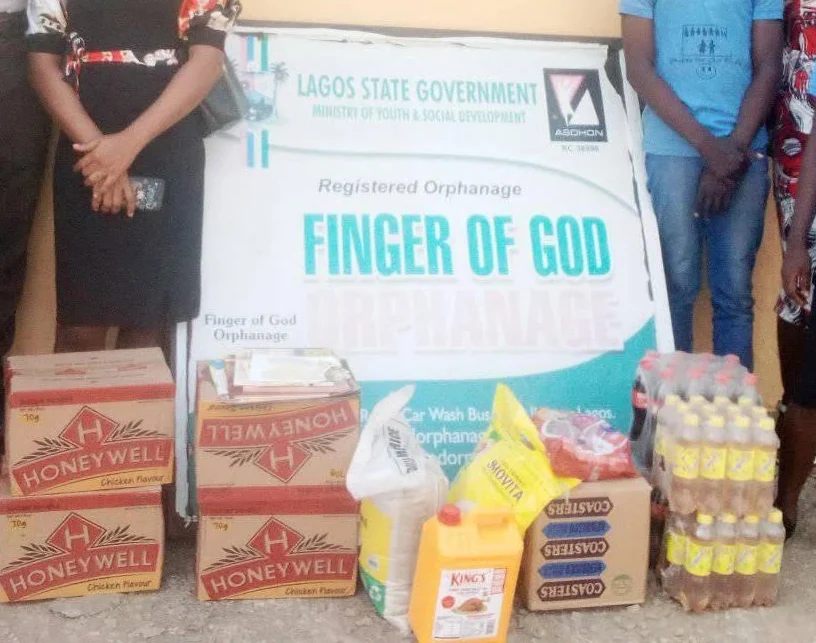
- What does the home actually need this month? Ask for a list. A delivery of things nobody asked for can create storage problems and waste.
Why we do not recommend orphanage visits or short-term volunteering
Many people want to spend a day with the children, take photos or volunteer for a week. It feels kind, but the evidence points the other way. According to the Better Care Network, volunteering in or visiting orphanages (Better Care Network (opens in a new tab)):
- encourages the expansion of orphanages;
- makes children vulnerable to abuse where regulation is lax;
- creates attachment problems in children who bond with short-term visitors and then feel abandoned when they leave;
- can raise the risk of unregulated adoption by volunteers who want to take a child home.
The network also warns that demand from donors and visitors has, in some countries, led to children from poor communities being exploited and trafficked to pose as orphans. In Lagos, the ministry has urged operators not to use children for forced labour or financial gain (NAN (opens in a new tab)).
For the same reason, please do not photograph children in a home or share their pictures online. SOVCI does not publish photos of children’s faces on this website.
Better ways to help
| Instead of… | Try… |
|---|---|
| Turning up with gifts and a camera | Asking the home for its current needs and arranging a delivery time with the staff |
| Spending a day playing with the children | Offering a professional skill to the home or to an NGO: book-keeping, record keeping, training or repairs |
| Posting photos of children online | Sharing the home’s or the NGO’s own updates, without children’s faces |
| Giving to a home you know nothing about | Giving to a registered home, or to organisations that strengthen families so children are not separated from them |
| Hoping to take a child home | Learning how fostering and adoption work through the ministry — see our fostering and adoption guide |
If you want to learn more about family-based care, the organisations on our Friends around the world page publish free guidance.
How SOVCI supports orphanage homes
Smiles for Orphans and Vulnerable Children Initiative (SOVCI) is a CAC-registered NGO in Ojo, Lagos. We take food, household supplies and school support to orphanage homes through outreaches, and we hold Children’s Day celebrations for children from homes and schools. For World Orphans Day 2025, our founder Euriel Momah, citing UNICEF, spoke of about 17.5 million orphaned children in Nigeria and called for support for their education, health care and protection (PUNCH Healthwise (opens in a new tab)).
We always ask homes what they need first, and we ask donors to contact us before delivering anything. You can read how on our page Support orphanage homes in Lagos.
Sources
All links were checked on 11 October 2026.
- News Agency of Nigeria (NAN), “Lagos pledges stronger protection, welfare for children in orphanage”, 1 July 2026 (opens in a new tab)
- NAN, “Lagos outlines regulatory compliance guidelines for orphanage homes”, 2 July 2026 (opens in a new tab)
- Better Care Network, “Orphanage Tourism, Voluntourism and Trafficking” (library section and key facts) (opens in a new tab)
- NAN, “Lagos convenes stakeholders meeting to strengthen adoption, fostering services”, 22 July 2026 (opens in a new tab)
- PUNCH Healthwise, “NGO raises the alarm over number of orphaned children”, 10 November 2025 (opens in a new tab)
Questions
Can I visit an orphanage in Lagos with gifts?
Contact the home first and ask what it needs; many homes prefer a planned delivery to a visit. Evidence collected by the Better Care Network shows that visits and short-term volunteering can harm children, so SOVCI does not recommend them, and you should never photograph the children.
How do I know an orphanage home is registered?
Ask the home to show its current registration and licence with the Lagos State Ministry of Youths and Social Development. In July 2026 the ministry said registration, licensing and periodic renewal are minimum standards for every home.
What is the most useful thing to give?
Whatever the home or the NGO tells you it needs right now. Ask for a list before you buy anything, and contact SOVCI if you would like to give through our outreaches.